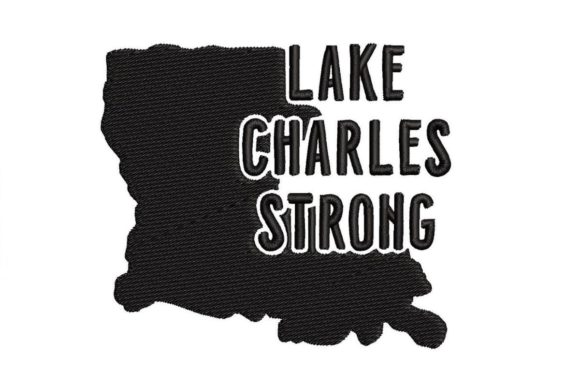
Lake Charles Strong
First Impressions: Bold, Warm, and Rooted
When I opened Lake Charles Strong for the first time, what struck me wasn’t just the words—but the weight behind them. This isn’t a flashy slogan or trend-chasing phrase. It’s grounded, sincere, and carries quiet pride. The lettering feels sturdy—slightly condensed, with clean curves and consistent stroke weight—ideal for satin stitch execution. There’s no excessive ornamentation, no distracting flourishes. That simplicity is its strength: it reads clearly at 3–4 inches wide on a tote bag, holds up well scaled down to 2 inches on a baby onesie, and doesn’t compete with fabric texture. As an embroidery designer who’s stitched hundreds of regional pride designs, I appreciate how Lake Charles Strong avoids cliché while still feeling unmistakably place-based.
A Real Project Test: Custom Sweatshirts for a Local Fundraiser
Last month, I used Lake Charles Strong on a batch of heavyweight cotton sweatshirts for a small community fundraiser. We chose charcoal heather fabric—soft but dense—and paired it with navy thread for contrast without harshness. The design stitched cleanly across all 24 pieces, with no skipped stitches or thread breaks. What stood out was how the rhythm of the letterforms translated into confident satin stitching: smooth, even, and legible even on slightly uneven fabric surfaces. Customers commented not just on the message, but on how “solid” it looked—like the embroidery itself mirrored the sentiment. That’s rare. Too many pride-based machine embroidery designs lean too light or too ornate; Lake Charles Strong lands right in the sweet spot between statement and substance.
Where It Shines (and Where to Pause)
Lake Charles Strong works especially well for:
- Custom apparel: Sweatshirts, crewnecks, and canvas tote bags—fabrics with body and low stretch that support crisp satin stitch definition.
- Embroidered patch production: Its clean lines and moderate height make it ideal for iron-on or sew-on patches, especially when backed with medium-weight cutaway stabilizer.
- Baby embroidery and nursery decor: On organic cotton onesies or pillow covers, it reads warmly—not loud or aggressive—making it a thoughtful personalized gift.
- Holiday and boutique merchandise: Paired with subtle seasonal accents (a single holly sprig, a snow-dusted “L” monogram), it adds local character to holiday embroidery without clashing.
Use caution on:
- Thin or highly textured fabrics: Lightweight rayon or heavily napped terry cloth may cause fill stitch distortion or shadowing—test first.
- Curved surfaces like caps: While legible, the straight-line layout doesn’t wrap naturally—consider repositioning or slight arc adjustment if using on structured headwear.
- Dark fabric + light thread combos: The design’s moderate density means pale thread (e.g., ecru or light gray) can fade visually. Stick to high-contrast pairings unless aiming for subtlety.
- Frequent-wash items like kitchen towels: Confirm stitch density supports durability—tighter fills hold up better over repeated laundering.
Design Integrity Meets Commercial Sense
As an Etsy seller and small shop product developer, I pay close attention to how a machine embroidery design affects perceived value. Lake Charles Strong elevates handmade presentation without requiring advanced digitizing skills—it’s accessible to intermediate crafters but polished enough for professional branding. When customers see it on a boutique apron or custom tea towel, they don’t think “generic font”—they feel intention. That builds trust. It also scales well across digital embroidery file previews and printable mockups, helping buyers visualize placement before purchase. For creative entrepreneurs building cohesive collections, this design fits naturally alongside other regional or community-focused embroidery assets—especially within the Around The World category—without needing heavy editing.
Practical Designer Notes Before You Stitch
Before adding Lake Charles Strong to your next project—or listing it as part of your craft business inventory—here’s what I always do:
- Test on scrap fabric matching your final garment’s weight and stretch.
- Check thread color contrast in natural light—not just on screen—to avoid surprises on dark or heathered backgrounds.
- Review stitch density: Look for tight fills in letter counters (like the “a” and “e”) and ensure running stitch outlines aren’t overly sparse.
- Confirm hoop size compatibility: If you’re using smaller hoops (4x4”), verify the full design fits—or plan for re-hooping.
- Inspect small details: Zoom in on corners and joins—clean transitions matter most on high-visibility items like caps or front-of-shirt placements.
- Test black-and-white mockups: Helps assess readability and balance before committing to color.
- Use appropriate stabilizer: Medium-cutaway for knits, tear-away for stable wovens—never skip this step.
- Verify licensing terms: Since this is a commercial embroidery file, confirm whether resale of finished products or redistribution of the digital embroidery file is permitted before listing on Etsy or in your small shop.
Final Thought: More Than Just Text
Lake Charles Strong succeeds because it understands its role—not as decoration, but as connection. It doesn’t shout. It stands. Whether stitched onto a child’s backpack, a volunteer’s apron, or a limited-run tote for a hometown festival, it carries quiet resonance. For designers, crafters, and small business owners, that kind of authenticity is gold: it translates directly into customer engagement, repeat orders, and word-of-mouth credibility. In a crowded field of embroidery file offerings, Lake Charles Strong earns its place—not by being the flashiest, but by being the truest. And in real-world embroidery work? That’s the kind of reliability you build a business on.